“Water is worth more than lithium,” Indigenous Argentine community tells COP30
Rich in lithium but poor in water, traditional Andean communities want the world to recognise the pitfalls of surging demand for minerals vital to the global energy transition
Protesters opposed to lithium mining hold up a banner that reads "without water there is no life". (Image: FARN)
Pia Marchegiani is environmental policy director and deputy director at Fundación Ambiente y Recursos Naturales (FARN), and Vanina Corral is FARN’s environmental policy programme officer.
At 3,400 metres (11,150 feet) above sea level in the arid highlands of northwest Argentina, 29-year-old Franco Vedia tends his llamas and fields in the Indigenous community of Tusaquillas – one of more than 30 communities across the Salinas Grandes and Laguna de Guayatayoc Basin.
Here, life revolves around a single, sacred element: water, the source that feeds the lagoon, sustains crops and animals, and has anchored centuries of Indigenous life.
Advertisement
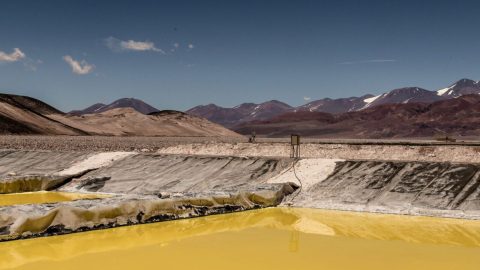
The Salinas Grandes, shared between the provinces of Jujuy and Salta, is one of the largest salt flats in South America. Beneath it lies another resource: lithium, the mineral driving the global race for batteries that power the energy transition.
“Lithium activity is water mining,” Franco said. “It consumes vast amounts of water in the Puna – a resource already scarce and extremely valuable here.”
Energy transition minerals may be tackled at UN climate talks for the first time, as resource-rich developing nations and Indigenous groups call for the industry’s costs and benefits to be fairly shared
President Javier Milei has slashed environmental spending since his 2023 election, putting forest defenders on alert in Gran Chaco, South America’s second-largest forest biome
Across Argentina’s northern provinces, environmental groups warn that lithium extraction has already dried rivers and degraded fragile Andean wetlands. The struggle of the Puna communities mirrors that of others across the Gran Atacama region – spanning Argentina, Chile and Bolivia – the so-called lithium triangle, home to more than half the world’s known reserves.
For communities like Franco’s, the balance kept for generations is breaking under a development model that promises progress at the cost of survival.
“If the water disappears, life disappears,” he added.
Families grow beans, potatoes and corn; raise llamas, sheep, and goats; and weave textiles by hand. In recent years, some have opened small community-based tourism projects. “We want to show the world how we work the land and what it means to us,” Franco said.
Advertisement
Their livelihoods sustain an ancient way of life – one now threatened by the expansion of lithium mining.
Salinas Grandes in Jujuy Province, Argentina (Photo: Courtesy of FARN)
Salinas Grandes in Jujuy Province, Argentina (Photo: Courtesy of FARN)
The energy transition paradox
Global demand for lithium is soaring as countries in the Global North accelerate their energy transitions. While lithium extraction is often portrayed as a solution to the climate crisis, the extraction process risks irreversible damage to fragile ecosystems such as the Andean wetlands.
Franco reflected on the global paradox of the energy transition: “We all use cellphones, computers and cars. It would be hard to imagine a world without technology. But what’s truly impossible is imagining a world without water.”
In the Andean cosmovision – a worldview that sees nature as part of the community – water is a living being. “When a water source is destroyed, a part of the community is destroyed. Without water, there is no balance and no existence,” Franco added.
A decade of community resistance
For more than 10 years, the Indigenous communities of Salinas Grandes and Laguna de Guayatayoc have resisted the entry of lithium companies. Mining projects have advanced without basin-wide environmental assessments or reliable baseline data – in a region already parched and vulnerable to climate change.
Their defence is not only of water and life, but of human rights: the right to information, participation and free, prior, and informed consent, guaranteed under the the UN-brokered Escazu Agreement, and the International Labour Organization’s Convention 169, a binding agreement concerning the rights of Indigenous peoples.
To protect their rights, the communities have taken their claims to national and international courts and created the Kachi Yupi Biocultural Protocol, defining how consultation must take place. Supported by organizations such as FARN (Environment and Natural Resources Foundation), they are building networks of technical and legal assistance.
Franco emphasised the importance of developing these networks to protect their territory: “It is very important for us that support comes from within, from our own people and from those individuals and organisations who want to defend life, the territory, Mother Earth, and the cosmovision of Buen Vivir.”
The road to COP30 in Belém
Franco will bring the voice of the Salinas Grandes to COP30 in Belém, Brazil.
“We want to show the world what is happening in our territories. Many communities across Latin America face the same situation. We need to unite our voices to defend water, human rights, and our collective right to live,” he said.
Many Indigenous communities in the region view water as a living being which needs to be protected. (Image: FARN)
Many Indigenous communities in the region view water as a living being which needs to be protected. (Image: FARN)
As the energy transition accelerates and minerals like lithium are treated as the next frontier, Franco carries an ancestral truth: “Water is worth more than lithium – because without water there is no life.”
Global call to rethink transition model
The defence of the Salinas Grandes Basin is more than a local struggle. It is a global call to rethink an energy-transition model that risks repeating the extractivism it claims to replace.
A truly just transition must respect community rights and participation, safeguard the ecosystems on which life depends, and place justice, equity and human rights at its core. The extraction of so-called critical minerals cannot repeat the same logic that has long harmed Indigenous peoples and degraded nature.
As COP30 gets underway, the proposed Belém Action Mechanism (BAM) – a civil-society call for a global just transition rooted in rights and ecological integrity – offers a path towards the transformation Franco’s community demands.
His message to Belém is simple and urgent: “The energy transition cannot be built on the destruction of water. True progress means caring for life.”
Our unprecedented reporting provides experts and professionals globally with the analysis and insight they need to navigate the most important climate issues.
Trusted by the UN, World Bank, and governments around the world, sign up today and see why our award-winning coverage has been considered the authority for almost 15 years.
Essential
£0
A few top stories each week alongside our Climate Weekly newsletter.
As the Iran war upends global energy markets, governments and consumers are cutting back – potentially locking in demand reductions that could lower the outlook for planet-heating emissions
Oil and gas blocks overlap with a fifth of forests in the Amazon, Congo Basin and SE Asia – policies are needed to transition away from fossil fuels and halt deforestation together
A Texas refinery shipping sustainable aviation fuel to Europe has sourced beef tallow with links to a meatpacking firm fined over illegal cattle purchases
As importers face new costs under the Carbon Border Adjustment Mechanism, many are finding the biggest savings do not necessarily come from swapping to cleaner production
As the Iran war upends global energy markets, governments and consumers are cutting back – potentially locking in demand reductions that could lower the outlook for planet-heating emissions
Oil and gas blocks overlap with a fifth of forests in the Amazon, Congo Basin and SE Asia – policies are needed to transition away from fossil fuels and halt deforestation together
New UN-supported forum should challenge a global system that leaves many Global South nations with zero fiscal breathing space to navigate climate disasters and economic crises
Amid aid cuts, donor governments pledge less nature and climate funding to the Global Environment Facility (GEF), with the four-year package to be finalised in late May
Meeting the goal requires political will and a pathway that brings together efforts and drives implementation. An international roadmap can deliver this
Stay ahead with our unrivalled coverage
We provide experts and professionals around the world with the analysis and insight they need to navigate the biggest climate issues and negotiations.
To provide the best experiences, we use technologies like cookies to store and/or access device information. Consenting to these technologies will allow us to process data such as browsing behavior or unique IDs on this site. Not consenting or withdrawing consent, may adversely affect certain features and functions.
Functional
Always active
The technical storage or access is strictly necessary for the legitimate purpose of enabling the use of a specific service explicitly requested by the subscriber or user, or for the sole purpose of carrying out the transmission of a communication over an electronic communications network.
Preferences
The technical storage or access is necessary for the legitimate purpose of storing preferences that are not requested by the subscriber or user.
Statistics
The technical storage or access that is used exclusively for statistical purposes.The technical storage or access that is used exclusively for anonymous statistical purposes. Without a subpoena, voluntary compliance on the part of your Internet Service Provider, or additional records from a third party, information stored or retrieved for this purpose alone cannot usually be used to identify you.
Marketing
The technical storage or access is required to create user profiles to send advertising, or to track the user on a website or across several websites for similar marketing purposes.