COP30’s headline win – the creation of the first global Just Transition mechanism – did not materialise overnight. Born out of years of work, it flourished during two weeks of civil society alignment in one of the few negotiating tracks that gained momentum
Anabella Rosemberg of CAN International delivers the final intervention by environmental NGOs at the closing COP30 plenary on November 22, 2025: "In the land of Chico Mendes and on the continent of Berta Cáceres, a promise has been made: that social and economic justice will no longer be treated as separate from climate action." (Photo: Teo Ormond-Skeaping)
Amid stalled talks on finance, adaptation and fossil fuel transition at the COP30 climate summit in Brazil’s Amazon region, governments agreed to an ambitious Just Transition package combining the strongest rights- and inclusion-based language yet seen in the UN climate process with a new global mechanism to support countries reshaping their economies.
The COP30 decision also confirmed that Just Transition must take a whole-of-society and whole-of-economy approach – covering mitigation, adaptation, loss and damage, and finance – a broad scope that observers said marked a significant step forward for the process.
Delegates described the outcome in the city of Belém as a rare convergence of political will, technical facilitation and years of groundwork by civil society and governments.
The decision also places stronger emphasis on the social and economic foundations of transition than many observers had expected. The text links Just Transition explicitly to poverty eradication and decent work, and recognises the need for just energy transitions as part of implementing the Global Stocktake – including the transition away from fossil fuels.
Finance provisions were also firmer than in previous drafts, with governments agreeing that support for Just Transition should prioritise grants and non-debt-creating instruments, a framing long pushed by developing countries and civil society.
Civil society kept the issue alive
The Work Programme on Just Transition, launched in 2022, remained low-profile across several COP cycles. Unions, youth networks, feminist groups, social movements and environmental organisations continued refining proposals and pushing negotiators even when political attention was limited – while activists also took to the streets across the world calling for a Just Transition.
As momentum built toward COP30, these groups began referring to their proposal as the Belém Action Mechanism – the “BAM” – signalling the level of institutional ambition they believed the process required. Alongside this sustained organising, unions stressed that Just Transition had to move beyond principles and into practice.
Key governments shifted earlier than expected
As colourful activists danced and chanted “We want the BAM!” in the COP30 conference centre, a key moment arrived on day two, when the G77+China group of developing countries came out early and clearly signalled its support for establishing a Just Transition mechanism. This leadership was widely described as the turning point that made an ambitious outcome possible.
The EU followed at the end of the first week, tabling a “bridging proposal” in the form of a Just Transition Action Plan. From that point, civil society campaigns intensified across the Global North, aimed at shifting governments that had so far resisted any new institutional arrangements.
The UK – initially identified by observers as the main hold-out – faced sustained campaigning, including an NGO sign-on letter and direct engagement with ministers. The political shift became visible inside the talks when Ed Miliband signalled support for the EU plan during the High-Level Ministerial Roundtable.
That shift extended beyond the UK. Canada, previously quiet on new institutional arrangements, began describing itself as “open to options” after targeted domestic media coverage. Australian civil society leveraged the country’s COP31 bid to draw attention to the need for coordination institutions, while NGOs in Belém maintained pressure on Swiss negotiators.
The push for the mechanism reached the highest level of the UN system. After a meeting with civil society, UN Secretary-General António Guterres added his voice of support for the mechanism and urged COP30 to operationalise a Just Transition aligned with 1.5°C.
Facilitators and ministers closed the gaps
Last year at COP29 in Baku, the Just Transition track ended without an outcome partly because no ministers were mandated to land one. Belém took a different approach: Mexico’s Alicia Bárcena and Poland’s Krzysztof Bolesta were appointed as ministerial leads and played a central role in balancing strong rights language with the institutional detail.
Technical co-facilitators Joseph Teo of Singapore and Federica Fricano of Italy were credited with producing a clear, workable draft that helped bridge divides. Delegates said its readability – unusual for UNFCCC text – helped maintain trust. UNFCCC secretariat staff supported the process with rapid revision work through the second week.
Brazil’s presidency and the significance of place
Brazil made Just Transition one of its three priorities, ensuring the track remained visible amid wider disputes.
The signal came early: at Climate Action Network’s Annual Strategy Meeting in Rio de Janeiro in February, attended by more than 170 climate justice activists, COP30 President Ambassador André Correa do Lago and COP30 CEO Ana Toni told participants that Just Transition would be a “vital” issue for COP30. The presidency also guided parties toward addressing the issue of “institutional arrangements” during the Pre-COP.
Belém’s context also mattered. The region is a long-standing focal point for debates over livelihoods, extractivism and environmental protection, grounding negotiations in lived realities.
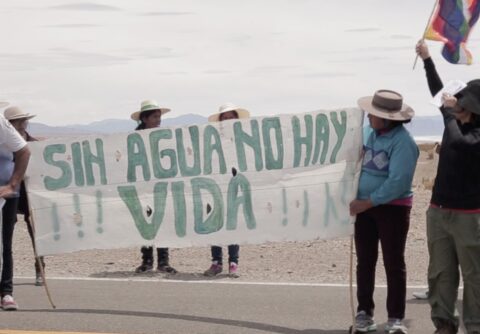
A symbol of this was the People’s March on the streets of Belém, with over 50,000 people participating, and thousands more across the world. The message of the Indigenous Peoples of the Amazon was clear: a Just Transition cannot be designed about them or around them – it must be shaped with them, and how transition minerals are managed is central to this.
An Indigenous person holds a sign reading: “Water is worth more than copper”, during a protest to call for climate justice and territorial protection during the U.N. Climate Change Conference (COP30), in Belem, Brazil, November 17, 2025. (Photo: REUTERS/Anderson Coelho)
An Indigenous person holds a sign reading: “Water is worth more than copper”, during a protest to call for climate justice and territorial protection during the U.N. Climate Change Conference (COP30), in Belem, Brazil, November 17, 2025. (Photo: REUTERS/Anderson Coelho)
What the decision changes
The final text sets out principles for rights-based, inclusive transitions and establishes a global mechanism to support countries in implementing these principles – elevating the mechanism to a structural component of how climate action will be delivered in the Paris Agreement era.
The agreement also reinforces the expectation that social and economic dimensions must be central to national climate plans, not appended to them.
Civil society will remain closely engaged as the mechanism takes shape, arguing that its effectiveness will depend on whether it reflects the realities facing workers, communities and families in transitions already underway.
The next phase will hinge on the operational details governments agree in the months ahead. Key questions include the design of the committee, what form secretariat support will take, and whether civil society and trade unions will have a formal seat in its work.
Parties will also need to decide whether the mechanism should help convene a wider network of practitioners. Its first workplan, the identification of support needs, and clarification of how it will interact with existing UNFCCC bodies, will shape how effective it becomes – with decisions expected at COP31.
Our unprecedented reporting provides experts and professionals globally with the analysis and insight they need to navigate the most important climate issues.
Trusted by the UN, World Bank, and governments around the world, sign up today and see why our award-winning coverage has been considered the authority for almost 15 years.
Essential
£0
A few top stories each week alongside our Climate Weekly newsletter.
Across Asia, the installation of early warning systems, alongside community involvement, is now viewed as a key response to the ever-present threat of climate disasters.
Spain has made good progress in supporting workers to transition away from fossil fuels. But trade unions are pushing for stronger efforts to renew rural life
Rich in lithium but poor in water, traditional Andean communities want the world to recognise the pitfalls of surging demand for minerals vital to the global energy transition
Across the world, people hosting renewable energy projects are seeing few rewards. Advocates say a Belém Action Mechanism could make the green transition fairer
As importers face new costs under the Carbon Border Adjustment Mechanism, many are finding the biggest savings do not necessarily come from swapping to cleaner production
As the Iran war upends global energy markets, governments and consumers are cutting back – potentially locking in demand reductions that could lower the outlook for planet-heating emissions
Oil and gas blocks overlap with a fifth of forests in the Amazon, Congo Basin and SE Asia – policies are needed to transition away from fossil fuels and halt deforestation together
New UN-supported forum should challenge a global system that leaves many Global South nations with zero fiscal breathing space to navigate climate disasters and economic crises
Amid aid cuts, donor governments pledge less nature and climate funding to the Global Environment Facility (GEF), with the four-year package to be finalised in late May
Meeting the goal requires political will and a pathway that brings together efforts and drives implementation. An international roadmap can deliver this
Stay ahead with our unrivalled coverage
We provide experts and professionals around the world with the analysis and insight they need to navigate the biggest climate issues and negotiations.
To provide the best experiences, we use technologies like cookies to store and/or access device information. Consenting to these technologies will allow us to process data such as browsing behavior or unique IDs on this site. Not consenting or withdrawing consent, may adversely affect certain features and functions.
Functional
Always active
The technical storage or access is strictly necessary for the legitimate purpose of enabling the use of a specific service explicitly requested by the subscriber or user, or for the sole purpose of carrying out the transmission of a communication over an electronic communications network.
Preferences
The technical storage or access is necessary for the legitimate purpose of storing preferences that are not requested by the subscriber or user.
Statistics
The technical storage or access that is used exclusively for statistical purposes.The technical storage or access that is used exclusively for anonymous statistical purposes. Without a subpoena, voluntary compliance on the part of your Internet Service Provider, or additional records from a third party, information stored or retrieved for this purpose alone cannot usually be used to identify you.
Marketing
The technical storage or access is required to create user profiles to send advertising, or to track the user on a website or across several websites for similar marketing purposes.