Q&A: China set to stay the course on green policies, despite Trump
China expert Rebecca Nadin of ODI Global tells Climate Home that Beijing will likely shrug off the US president’s attacks on climate action and trade relations
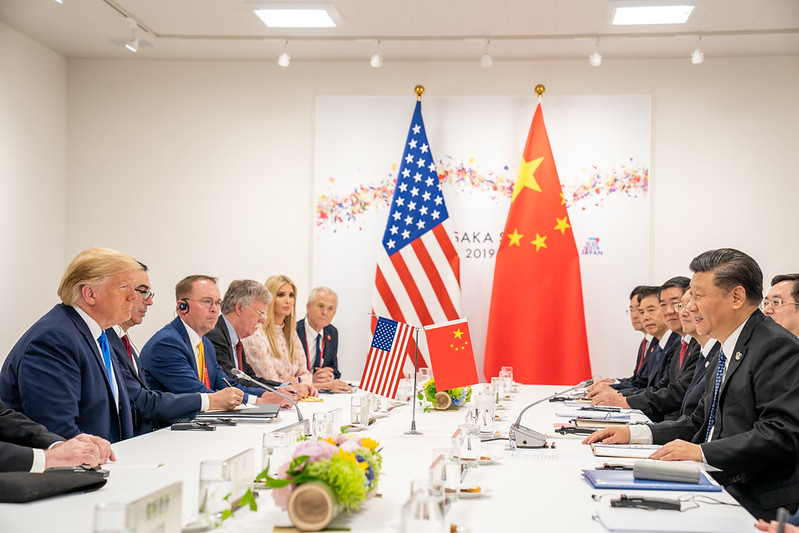
Donald Trump and Xi Jinping meet at the G20 summit in Osaka, Japan, on June 29 2019 (Photo: Shealah Craighead/White House)
Since Donald Trump came to power as US president in January, he has started the process to exit the Paris climate accord, slashed US spending on climate programmes at home and abroad, and slapped a 20% tariff on all Chinese imports.
These moves have raised questions about whether China will seize the opportunity to step up its global leadership on clean energy and align more closely with other supporters of the international climate regime.
Climate Home spoke to China specialist Rebecca Nadin about what Trump’s offensive on trade and the green transition could mean for relations between the world’s two biggest carbon emitters and for China’s climate policies.
Advertisement
Nadin is the director of the global risks and resilience team at ODI Global, a London-based think tank. She previously worked in China, advising the government on adaptation to climate change. Before that, she worked in the British Embassy in Beijing, specialising in Japan-China relations, Central Asia and energy security.
Climate Home:How might Trump’s abandonment of US and international climate action and efforts to use trade as a bargaining chip affect China’s climate policy?
Nadin: It won’t change too much. China will do what China’s doing. The climate community is calling on China to step up now and be this global leader – but its climate trajectory will always depend on how economically and domestically advantageous that is to China.
Donald Trump has pitched himself as “the tariffs guy” and you might think he would want to crush China’s dominant renewables sector. But Biden also put tariffs on the Chinese solar industry – so, in reality, that’s not such a shift.
Similarly, the Biden administration promoted mining of minerals needed for the energy transition in places like Zambia. Even if Trump doesn’t give a damn about the energy transition, a lot of these minerals are useful for the military or information technology, so this policy won’t change too much.
China set out very clearly in its 14th five-year plan that it wants to dominate renewable energy. In 2023, it accounted for 65% of global wind capacity, and it also dominates the production and building of ships that are needed to transport offshore wind [equipment]. And it dominates the supply chain of a lot of those minerals that are needed for renewable tech.
Advertisement
It’s just announced a big investment, for example, in Kazakhstan in wind. So it is going to carry on doing that because, actually, I think the US market for China is relatively small. Most of China’s renewable tech focus is pretty much Southeast Asia – it’s regional.
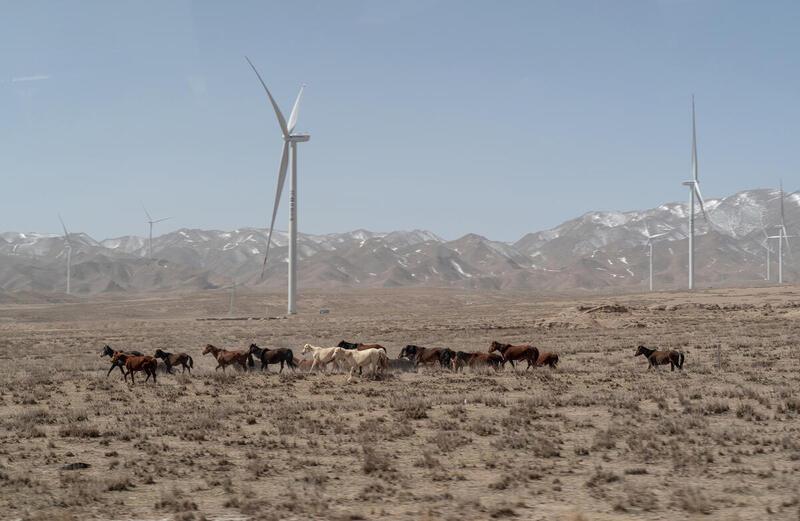
A herd of horses ran around a wind farm in Gansu province, Yongchang County, Jinchang City on April 26 2023. (Photo: Li Juanhui / Huafeng Innovation / Greenpeace)
Then this month, in what some are interpreting as a step to take on the mantle of global climate leadership, Chinese Premier Li Qiang noted that China would “actively engage in, and steer global environmental and climate governance”.
This is a welcome sign, but don’t expect any shift in terms of finance beyond what was agreed at COP29, where China agreed to a formula for the new finance goal for climate-vulnerable countries that would allow its contributions to be counted on a voluntary basis. China will continue to remind the world that it is willing, though not obliged, to help developing countries enhance their adaptability through South-South cooperation.
Q: How would you interpret the latest government announcements on China’s energy and economic policies – do they show that Beijing is serious about keeping up momentum towards its climate goals?
A: In December 2024, the state-owned oil refiner Sinopec announced that China’s oil consumption would peak in 2027. That’s quite a big statement! This is as demand for new energy vehicles, which don’t need oil, is soaring in China. On the other hand, they predict that demand for oil for jet and ship fuel will increase.
The other thing that struck me recently was from the Central Economic Work Conference. It’s one of the most important meetings of the Politburo that effectively sets China’s economic priorities and strategies. In 2024, there was not much mention of climate issues there, as it was all recovery from COVID-19 and the economic downturn, but this year you saw a real focus on the need to “advance China’s green low-carbon transition”.
And just this month Premier Li stressed that China would continue to move towards peaking carbon emissions and achieving carbon neutrality with an acceleration of the integration of renewable energy into local grids and the construction of transmission routes. He also addressed the “coal conundrum” by indicating that China is going to launch low-carbon upgrade pilots for some of its coal-fired power plants.
With China, you have to be very pragmatic. In some areas, China’s doing good stuff. In others, it’s not. People put it in this area of “you’re a hawk or a dove” – and that’s just not a good way of understanding it.
Q:For example, China recently announced a package of major clean energy projects in a bid to peak emissions by 2030 and become carbon-neutral by 2060 – but it also plans to keep increasing coal production too. What explains these seeming contradictions?
A: China is exposed to huge climate change risk – and it knows that. It also wants to keep benefiting from its world-leading renewable and green technology industries and, as an energy security-poor nation, to develop domestic renewable energy.
On the other hand, coal is still a primary energy source for China and that is because these energy sectors are still big employers in the poorest parts of the country – the industrial heartlands. Like other countries, China has to balance that just transition [away from coal] as well.
A child at a fence looks at a power plant in Inner Mongolia, on 2 May 2012 (Photo: Lu Guang/Greenpeace)
There is a stark realisation in China that the coal industry and the heavy polluting industries are big employers and that these individual provinces need to be supported in a transition away from that. These provinces can be huge – some have more than 100 million people – so it’s difficult. It’s like transitioning several countries.
But [the Chinese authorities] have always understood the socio-economic benefits of addressing climate change. Even in the 1990s, climate policy was moved from the China Meteorological Administration to the predecessor of the National Development and Reform Commission. That showed they saw it not just as an environmental issue but as an issue of socio-economic development.
Q:China’s National Development and Reform Commission recently proposed a huge hydropower dam on the Tibetan plateau. What will be the implications of that – and is it a positive move?
A: The Tibetan Plateau is basically the Third Pole. It’s like the water tower of Asia – you’ve got all these major rivers in the Hindu Kush Himalaya basin. Putting a dam up in the Yarlung Tsangpo River would allow China to effectively control the lower riparian countries – India, Bangladesh – which originate rivers in the Brahmaputra. This could be really, really serious.
The engineering that’s required to build this dam is phenomenal because they’re effectively going to have to tunnel through the mountain, and this gorge is something like 3,000 metres deep. So what they’re expecting is that with the power of the water dropping through this gorge, the power production would be two or three times that of the Three Gorges Dam.
As the climate community, we need to also think a little bit about some of the trade-offs. China will meet its renewable energy targets with this dam, but then potentially you’ve got a massive issue with water flow into Bangladesh, India, Laos and all those countries. And the sediment – this is what happened with the Three Gorges [in the 1950s] – they dammed the Yellow River and all the sediment was trapped behind the dam. Then they had to release it. This basically messes up the soil (and) the nutrients. So you solve one problem, but you create another.
Our unprecedented reporting provides experts and professionals globally with the analysis and insight they need to navigate the most important climate issues.
Trusted by the UN, World Bank, and governments around the world, sign up today and see why our award-winning coverage has been considered the authority for almost 15 years.
Essential
£0
A few top stories each week alongside our Climate Weekly newsletter.
Across Asia, the installation of early warning systems, alongside community involvement, is now viewed as a key response to the ever-present threat of climate disasters.
COP30’s headline win – the creation of the first global Just Transition mechanism – did not materialise overnight. Born out of years of work, it flourished during two weeks of civil society alignment in one of the few negotiating tracks that gained momentum
Spain has made good progress in supporting workers to transition away from fossil fuels. But trade unions are pushing for stronger efforts to renew rural life
Rich in lithium but poor in water, traditional Andean communities want the world to recognise the pitfalls of surging demand for minerals vital to the global energy transition
Across the world, people hosting renewable energy projects are seeing few rewards. Advocates say a Belém Action Mechanism could make the green transition fairer
As importers face new costs under the Carbon Border Adjustment Mechanism, many are finding the biggest savings do not necessarily come from swapping to cleaner production
As the Iran war upends global energy markets, governments and consumers are cutting back – potentially locking in demand reductions that could lower the outlook for planet-heating emissions
Oil and gas blocks overlap with a fifth of forests in the Amazon, Congo Basin and SE Asia – policies are needed to transition away from fossil fuels and halt deforestation together
New UN-supported forum should challenge a global system that leaves many Global South nations with zero fiscal breathing space to navigate climate disasters and economic crises
Amid aid cuts, donor governments pledge less nature and climate funding to the Global Environment Facility (GEF), with the four-year package to be finalised in late May
Meeting the goal requires political will and a pathway that brings together efforts and drives implementation. An international roadmap can deliver this
Stay ahead with our unrivalled coverage
We provide experts and professionals around the world with the analysis and insight they need to navigate the biggest climate issues and negotiations.
To provide the best experiences, we use technologies like cookies to store and/or access device information. Consenting to these technologies will allow us to process data such as browsing behavior or unique IDs on this site. Not consenting or withdrawing consent, may adversely affect certain features and functions.
Functional
Always active
The technical storage or access is strictly necessary for the legitimate purpose of enabling the use of a specific service explicitly requested by the subscriber or user, or for the sole purpose of carrying out the transmission of a communication over an electronic communications network.
Preferences
The technical storage or access is necessary for the legitimate purpose of storing preferences that are not requested by the subscriber or user.
Statistics
The technical storage or access that is used exclusively for statistical purposes.The technical storage or access that is used exclusively for anonymous statistical purposes. Without a subpoena, voluntary compliance on the part of your Internet Service Provider, or additional records from a third party, information stored or retrieved for this purpose alone cannot usually be used to identify you.
Marketing
The technical storage or access is required to create user profiles to send advertising, or to track the user on a website or across several websites for similar marketing purposes.