It was an inspired idea – bring together 100 of today’s boldest women leaders in sustainability, and see if they can produce an accelerated, gender-aware climate action agenda which can be implemented everywhere, from households and communities to boardrooms and negotiation halls.
Advertisement
One of its organizers, Osprey Orielle Lake first approached me about the idea at the Durban climate conference in December 2011. And now it’s happening – the International Women’s Earth and Climate Summit kicks off on Friday in New York.
The nature of the gathering might leave some asking: are women uniquely positioned to tackle climate change?
Data and knowledge of climate impacts that are gender blind — that lump men and women together — make invisible the disproportionate toll that climate change takes on women. It also hides the important knowledge that women have of climate change, its causes and its solutions.
Women are more vulnerable to climate impacts due to their unequal position in society.
Women are disproportionately affected by natural disasters: after the 2004 Asia tsunami men outlived women 3:1, and women who survived Hurricane Katrina faced additional personal danger (rape, for example) and discrimination in comparison to male survivors.
In the developing world, women stand at the nexus of food, water, and energy. It is women who are responsible for food production and the collection of water and fuel wood, which makes them keenly aware of changing weather patterns that alter growing seasons, decrease crop yields and lower water levels.
Advertisement
Adaptation pioneers
With their unique knowledge and perspectives, women hold the keys to adaptation strategies and are critical to implementing mitigation plans at the grassroots level.
The Barefoot College in India trains women to be solar engineers, simultaneously bringing electricity to communities, avoiding additional carbon emissions and empowering women with valuable skills.
Energia International, led largely by women, uses knowledge of gender norms in the areas where they work in order to better implement clean energy solutions varying from solar grid installation to clean cook stove projects.
But it’s not just women in the developing world who play a central role in the fight against climate change. Polling in the developed world (in Germany, Australia, and the US) indicates that women see climate change as real and dangerous in higher numbers than men, and they’re more likely to take action against it.
In Germany, the polling also revealed that women are more likely to believe in the power of the individual to protect the climate. That kind of empowered thinking drives NGOs like One Million Women, which works to inspire one million women to cut one ton of carbon dioxide from their daily lives.
Women in high powered leadership positions also bring something unique to the table. For example, though women are only a small proportion of corporate boards, their presence is critical for bringing fresh vision to company governance.
New thinking
A study on gender inclusion on boards found that having at least three women – a number that exceeds simple ‘tokenism’ – caused a fundamental change and improvement in a board’s decision-making: the perspectives of more stakeholders were addressed; controversial issues were tackled instead of ignored; and the dynamic of the group was more open and collaborative.
Imagine if this experience were applied to the UNFCCC negotiations, where women are outnumbered by their male counterparts on the order of three to one, and where only 15% of country delegations are led by women.
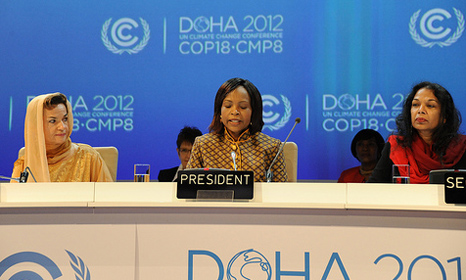
At last year’s conference in Doha a landmark agreement to promote gender balance in the negotiations was adopted, an important step in the right direction. And let’s remember, this isn’t just about fairness, but about improving the quality of decision-making, as women bring important – and different – perspectives and critical knowledge to climate talks.
So to answer my own question, are women uniquely positioned to tackle climate change? I say yes, for the reasons explained above. But being uniquely positioned is not the same thing as being solely positioned. When it comes to climate change, everyone has an important part to play.
With that in mind, I’m excited to attend the summit, to collaborate with a group of incredibly passionate women from around the world, and to see what emerges from these discussions. And those who are not in New York are encouraged to join the Summit through interactive live-streaming during the plenary sessions each day.
It will be a powerful opportunity to elevate the voices of those still underrepresented in discussions about climate action, and to promote stronger solutions as a result.
Kelly Rigg is the Executive Director of the Global Campaign for Climate Action, a global alliance of 350 organizations cooperating under the banner of the tcktcktck campaign. She has been leading international campaigns for 30 years on climate, energy, oceans, Antarctica and other issues. Follow her on Twitter @kellyrigg
Our unprecedented reporting provides experts and professionals globally with the analysis and insight they need to navigate the most important climate issues.
Trusted by the UN, World Bank, and governments around the world, sign up today and see why our award-winning coverage has been considered the authority for almost 15 years.
Essential
£0
A few top stories each week alongside our Climate Weekly newsletter.
As importers face new costs under the Carbon Border Adjustment Mechanism, many are finding the biggest savings do not necessarily come from swapping to cleaner production
Oil and gas blocks overlap with a fifth of forests in the Amazon, Congo Basin and SE Asia – policies are needed to transition away from fossil fuels and halt deforestation together
New UN-supported forum should challenge a global system that leaves many Global South nations with zero fiscal breathing space to navigate climate disasters and economic crises
Meeting the goal requires political will and a pathway that brings together efforts and drives implementation. An international roadmap can deliver this
As Middle East conflict rattles energy markets, Barbados charts a practical path for small islands to harness abundant renewables and strengthen energy security
As importers face new costs under the Carbon Border Adjustment Mechanism, many are finding the biggest savings do not necessarily come from swapping to cleaner production
As the Iran war upends global energy markets, governments and consumers are cutting back – potentially locking in demand reductions that could lower the outlook for planet-heating emissions
Oil and gas blocks overlap with a fifth of forests in the Amazon, Congo Basin and SE Asia – policies are needed to transition away from fossil fuels and halt deforestation together
New UN-supported forum should challenge a global system that leaves many Global South nations with zero fiscal breathing space to navigate climate disasters and economic crises
Amid aid cuts, donor governments pledge less nature and climate funding to the Global Environment Facility (GEF), with the four-year package to be finalised in late May
Meeting the goal requires political will and a pathway that brings together efforts and drives implementation. An international roadmap can deliver this
Stay ahead with our unrivalled coverage
We provide experts and professionals around the world with the analysis and insight they need to navigate the biggest climate issues and negotiations.
To provide the best experiences, we use technologies like cookies to store and/or access device information. Consenting to these technologies will allow us to process data such as browsing behavior or unique IDs on this site. Not consenting or withdrawing consent, may adversely affect certain features and functions.
Functional
Always active
The technical storage or access is strictly necessary for the legitimate purpose of enabling the use of a specific service explicitly requested by the subscriber or user, or for the sole purpose of carrying out the transmission of a communication over an electronic communications network.
Preferences
The technical storage or access is necessary for the legitimate purpose of storing preferences that are not requested by the subscriber or user.
Statistics
The technical storage or access that is used exclusively for statistical purposes.The technical storage or access that is used exclusively for anonymous statistical purposes. Without a subpoena, voluntary compliance on the part of your Internet Service Provider, or additional records from a third party, information stored or retrieved for this purpose alone cannot usually be used to identify you.
Marketing
The technical storage or access is required to create user profiles to send advertising, or to track the user on a website or across several websites for similar marketing purposes.