Up until the late summer of 2013 climate policy was, in the English speaking world at least, nothing more than a polite parlour game.
Advertisement
Once it became apparent, circa 1988, that the speed and extent of the industrial transformation of our atmosphere could no longer be ignored, charismatic political figures set about showing the world they were taking the issue seriously.
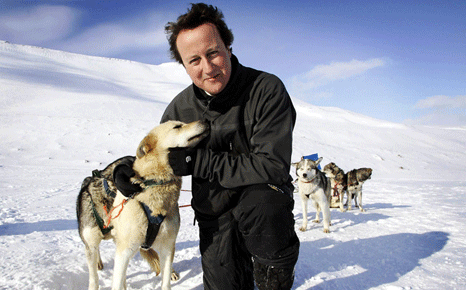
In the UK the Prime Minister has engaged in symbolic photo shoots riding skidoos across the Arctic ice. In the US, Vice president Al Gore made a film about climate change, and Obama has spoken about the need for action.
Even George W. Bush, in explaining his decision to not ratify the Kyoto protocol, still felt it necessary to play the game, and stressed the need for the US to “diversify away from fossil fuels.”
The then Australian Prime Minister Kevin Rudd, having declared climate change “the greatest moral, economic and social challenge of our time” signed Australia up to the Kyoto Protocol in 2007.
However, his move from this empty symbolism into real climate policy proved his downfall; when Rudd attempted to impose a resource tax, the mining companies fought back and Labour, desperate to appease their paymasters, promptly replaced him with Julia Gillard, who set about reforming the resource tax into just another toothless piece of climate legislation.
False hope
Advertisement
Most climate policy of the past 25 years has the same kind of relationship to the radical responses demanded by the science as a charades mime has to the film or book which the players are being asked to guess.
The academic Ingolfur Bludhorn has described this simulacrum of meaningful action as ‘symbolic politics’.
He argues that symbolic politics, whilst as old as society itself, has reached new levels of significance as the challenges facing humanity become more complex. But, he suggests, symbolic politics can only get us so far. At some point reality catches up with the symbolism, and the chickens come home to roost.
The end game for symbolic climate change politics has arrived. But rather than replacing the pretence of symbolic climate politics with meaningful policies, we are seeing the reverse, the rejection, in the Anglo Saxon world at least, of climate politics in all its forms, symbolic or otherwise.
The new Australian Prime Minister has consigned climate change to the dustbin of policy making.
In September George Osborne, UK Chancellor of the Exchequer, proclaimed that he didn’t want the UK to be at the forefront of efforts to tackle climate change, (an amusing statement, a bit like my Gran saying she doesn’t want to compete in the Olympics 100 metres final.)
Then, on Monday 30 September, following the release of the IPCC’s Fifth Assessment Report, the UK government’s Environment Secretary, Owen Patterson, told delegates at the Conservative Party’s annual conference that we should just accept the climate has been changing for centuries, and any further increases in temperature were likely to be quite modest and have a number of beneficial impacts.
Two degrees
But why now? Why at the very point that the IPCC have removed any doubt about the anthropogenic nature of climate change would Western decision makers choose to abandon all pretence that they were ever serious about climate mitigation?
I would argue it is because the ultimate symbolism of climate policy now demands a response; the two degree dangerous limit idea.
The promise that climate change won’t become dangerous anytime soon can no longer be deployed to forestall the need for radical action to reduce emissions. That, after all, is what environmental limits are for; not to limit industrial activity, but enable it.
Following Fukushima, safe levels for radiation exposure were increased so that children could go back to schools that, under the previous safety levels, were declared out of bounds.
Aeroplanes were grounded across Europe in 2010 because there was no such thing as a safe level of volcanic ash for planes to fly through. It therefore became necessary to define a safe level so that flights could recommence.
And so it is with the two degree dangerous limit – it was only ever intended to allow for the continuance of business as usual in the face of the certain knowledge that industrial activity was driving atmospheric concentrations of greenhouse gases to levels higher than anything in the history of human existence.
The search for energy substitutes was meant to have delivered a solution by now. It hasn’t, and time is up; two degrees of warming cannot be avoided under business as usual scenarios.
The game of charades is now over. It is decision time – capitalism vs observance of the two degree warming limit or, in the very optimistic words of Buckminster Fuller, ‘utopia or oblivion’.
The last month of policy announcements show our political class have made their choice.
Christopher Shaw is an inter-disciplinary researcher at the University of Oxford with eight years of experience in research in the area of climate policy, social geography, public engagement and socio-technical transitions. Follow him @kalahar1
Our unprecedented reporting provides experts and professionals globally with the analysis and insight they need to navigate the most important climate issues.
Trusted by the UN, World Bank, and governments around the world, sign up today and see why our award-winning coverage has been considered the authority for almost 15 years.
Essential
£0
A few top stories each week alongside our Climate Weekly newsletter.
As importers face new costs under the Carbon Border Adjustment Mechanism, many are finding the biggest savings do not necessarily come from swapping to cleaner production
Oil and gas blocks overlap with a fifth of forests in the Amazon, Congo Basin and SE Asia – policies are needed to transition away from fossil fuels and halt deforestation together
New UN-supported forum should challenge a global system that leaves many Global South nations with zero fiscal breathing space to navigate climate disasters and economic crises
Meeting the goal requires political will and a pathway that brings together efforts and drives implementation. An international roadmap can deliver this
As Middle East conflict rattles energy markets, Barbados charts a practical path for small islands to harness abundant renewables and strengthen energy security
As importers face new costs under the Carbon Border Adjustment Mechanism, many are finding the biggest savings do not necessarily come from swapping to cleaner production
As the Iran war upends global energy markets, governments and consumers are cutting back – potentially locking in demand reductions that could lower the outlook for planet-heating emissions
Oil and gas blocks overlap with a fifth of forests in the Amazon, Congo Basin and SE Asia – policies are needed to transition away from fossil fuels and halt deforestation together
New UN-supported forum should challenge a global system that leaves many Global South nations with zero fiscal breathing space to navigate climate disasters and economic crises
Amid aid cuts, donor governments pledge less nature and climate funding to the Global Environment Facility (GEF), with the four-year package to be finalised in late May
Meeting the goal requires political will and a pathway that brings together efforts and drives implementation. An international roadmap can deliver this
Stay ahead with our unrivalled coverage
We provide experts and professionals around the world with the analysis and insight they need to navigate the biggest climate issues and negotiations.
To provide the best experiences, we use technologies like cookies to store and/or access device information. Consenting to these technologies will allow us to process data such as browsing behavior or unique IDs on this site. Not consenting or withdrawing consent, may adversely affect certain features and functions.
Functional
Always active
The technical storage or access is strictly necessary for the legitimate purpose of enabling the use of a specific service explicitly requested by the subscriber or user, or for the sole purpose of carrying out the transmission of a communication over an electronic communications network.
Preferences
The technical storage or access is necessary for the legitimate purpose of storing preferences that are not requested by the subscriber or user.
Statistics
The technical storage or access that is used exclusively for statistical purposes.The technical storage or access that is used exclusively for anonymous statistical purposes. Without a subpoena, voluntary compliance on the part of your Internet Service Provider, or additional records from a third party, information stored or retrieved for this purpose alone cannot usually be used to identify you.
Marketing
The technical storage or access is required to create user profiles to send advertising, or to track the user on a website or across several websites for similar marketing purposes.