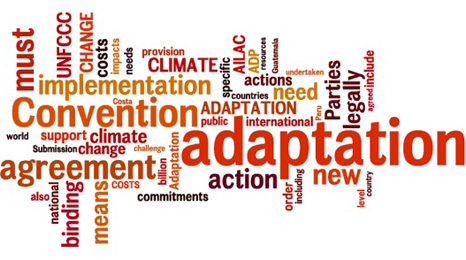
This post constitutes the second part of an analysis of countries and coalitions’ positions on the 2015 global climate agreement currently under negotiations at the UN climate negotiations.
Advertisement
The visualizations below are based on the written submissions provided by countries ahead of the Warsaw climate conference.
This second section provides short analyses of the positions of industrialized countries (NB: these categories are only used here in order to structure the analysis).
For additional background information – including a short introduction to the art of reading “word clouds” – and a commentary on the positions of developing countries, please refer to the first part of this analysis.
US (ABOVE): a “race to the top” lacking a goal post
The submission of the United States builds on the country’s proposal for a “race to the top” building on nationally determined pledges and the hope that ambitious action by some will emulate others. The submission acknowledges that this approach provides no guarantee to deliver the level of commitment required to reach the common objective but suggests that pressure will ultimately build on parties to do so.
The country calls for the ongoing negotiations to deliver a concise agreement in 2015 with some details on the rules allowing for a transparent assessment of national action and a mix between binding and aspirational commitments. Mitigation commitments would be registered in a separate schedule, after a consultative phase to begin in March 2015. The submission lists the information that should be provided by parties in order to enable countries to compare their efforts.
Advertisement
Finally, in relation to the role of finance in the post-2020 framework, the US emphasizes the importance of redirecting investment flows and the role that climate finance can play to provide positive incentives for this to happen.
EU: trust as the driver of ambition
The submission of the European Union (on behalf of 34 countries) emphasizes the need to accelerate the negotiation process. The EU calls for the adoption in 2015 of an ambitious, legally binding protocol with global participation and informed by science. The protocol should be applicable to all on the basis of their “fair share” (defined by the EU as based on evolving responsibilities and capabilities). It also emphasizes its expectation that the negotiations will result in a comprehensive package addressing not only mitigation but also adaptation, means of implementation and transparency.
Where the US and some other developed countries see flexibility and pragmatism as a driver for ambition, the EU emphasizes trust (through the implementation of a robust rules-based system) as the key to delivering stronger mitigation action. It therefore calls for the adoption of a legally binding reporting and accounting framework building both on the Kyoto Protocol and on the processes adopted after the Cancun Agreements, including through capacity building when necessary in relation to reporting obligations.
The block calls for further discussion in November on the operationalization of finance. It suggests that all parties make initial offers in 2014 in relation to their mitigation commitments thus allowing for a step-by-step review process afterwards. Such commitments should be economy wide emissions reductions targets for countries already having such obligations or other types of commitments based on national circumstances for other parties with the objective of seeing all countries eventually converge towards the first type of commitments.
EIG: an ambitious instrument with legally binding commitments for all
The Environmental Integrity Group (Liechtenstein, Mexico, Monaco, Rep. of Korea, and Switzerland) is straightforward about its expectations: a legally binding instrument with sufficient ambition, comprehensive participation and effective compliance mechanisms. The five countries emphasize their vision of the principle of common but differentiated responsibility & respective capacities (CBDR/RC) as an enabler for further ambition, based on a “dynamic and flexible framework”.
In relation to mitigation, their submission emphasizes the need for all commitments to take the same legal form and be under the same rules, with the type, stringency and timing of actions varying based on CBDR/RC and equity. The EIG provides additional information in relation to its expectations on accounting, verification and compliance of the commitments. While the group emphasizes the importance to make progress in Warsaw on the modalities and timeline of the consultative phase which would allow the review of national commitments, the countries did not provide further detail their views on this matter.
New Zealand: an ambitious dismantling of the multilateral framework
New Zealand’s position is based on a hybrid approach between a bottom-up approach and a top-down regime, with flexibility as the key word. The limited top-down elements envisioned by the country are an obligation to adopt mitigation actions and a commitment to respect transparency requirements in the reporting of domestic actions. Accordingly, the 2015 agreement would also contain a global aspirational goal and a general commitment for all countries to improve ambition over time. New Zealand rejects any equity formula to assess the adequacy of national actions.
The submission then details the bottom-up elements that the country advocates for: the national determination of actions, based on methodologies chosen at the discretion of each countries, and coupled with the possibility for additional “op-ins” (flexibility mechanisms) and “op-outs” (to exclude one sector from its accounting). In relation to the negotiations timeframe, the country suggests that national commitments be registered sometime after 2015, once a set of conditions is met. No reference is made to guaranteeing that such a hybrid approach would guarantee that countries deliver the final objective of the convention.
Japan: a flexible regime
The Japanese submission suggests taking into account the G8 “proposal” of reducing global emissions by 50% in 2050 (developed countries reducing their own emissions by 80%). The vision of the country for the post 2020 climate agreement is defined as a flexible hybrid system with nationally determined commitments based on internationally-agreed rules. The submission of these commitments would then be followed by an international review process.
The country’s submission provides detailed information on expectations for the “ex-ante” consultation allowing the review national commitments internationally before their inscription in the new agreement as well as on the “ex-post” review of the progress made by countries to implement their commitments. Additional flexibility is suggested by the country in relation to the timeframe for the submission of commitments as well as with the possibility to demonstrate a country’s actions on climate change through other criteria than emission reductions.
AILAC: “means of implementation” as a key enabler
The submission by the Independent Alliance of Latin America and the Caribbean (“AILAC”, composed of Chile, Colombia, Costa Rica, Guatemala, Panamá & Perú) focuses on the role of two core elements: the importance of a new framework for adaptation and the role of means of implementation (financial and technological support as well as capacity building) in the new framework. The coalition provides a useful reminder of the role that these resources play in the intergovernmental process: contributing to the achievement of the global goals as facilitating the increase of ambition as well as enabling compliance, for instance in providing resources for countries to implement adequate reporting of their actions. The group suggests that both of those aspects should be considered when defining provisions related to means of implementation in the post 2020 regime. AILAC also emphasizes the importance for negotiations related to means of implementations to follow the same timeframe as the discussions focused on mitigation commitments.
Singapore: championing a purely bottom-up approach
As one of the richest countries falling outside of the scope of the Annex 1 to the climate convention, Singapore reiterated the importance of building on the structure provided by the Convention and its Annexes in the post 2020 regime. Its submission emphasized the importance of the participation by all countries to the new climate framework as well as the key role of acknowledging national circumstances in achieving this universal participation. The country proposes that national determined mitigation commitments be submitted in 2015. No mention is made in the country’s position to any type of review of these commitments before those are registered in the 2015 climate agreement, thus suggesting a purely “bottom-up” approach.
The author would like to thank those having provided comments since the publication of the first part of this analysis.
Disclaimer: additional parties have also submitted their written position on the 2015 climate agreement. The Coalition for Rainforest Nations’ submission focuses mainly on REDD+ related elements. The Russian position is sadly available only in Russian language. Finally Uzbekistan and Turkey have also contributed in written to this process.
At the time of the publication of this analysis, neither China nor AOSIS (the Alliance of Small Islands States) had provided their written input.
Our unprecedented reporting provides experts and professionals globally with the analysis and insight they need to navigate the most important climate issues.
Trusted by the UN, World Bank, and governments around the world, sign up today and see why our award-winning coverage has been considered the authority for almost 15 years.
Essential
£0
A few top stories each week alongside our Climate Weekly newsletter.
As importers face new costs under the Carbon Border Adjustment Mechanism, many are finding the biggest savings do not necessarily come from swapping to cleaner production
Oil and gas blocks overlap with a fifth of forests in the Amazon, Congo Basin and SE Asia – policies are needed to transition away from fossil fuels and halt deforestation together
New UN-supported forum should challenge a global system that leaves many Global South nations with zero fiscal breathing space to navigate climate disasters and economic crises
Meeting the goal requires political will and a pathway that brings together efforts and drives implementation. An international roadmap can deliver this
As Middle East conflict rattles energy markets, Barbados charts a practical path for small islands to harness abundant renewables and strengthen energy security
As importers face new costs under the Carbon Border Adjustment Mechanism, many are finding the biggest savings do not necessarily come from swapping to cleaner production
As the Iran war upends global energy markets, governments and consumers are cutting back – potentially locking in demand reductions that could lower the outlook for planet-heating emissions
Oil and gas blocks overlap with a fifth of forests in the Amazon, Congo Basin and SE Asia – policies are needed to transition away from fossil fuels and halt deforestation together
New UN-supported forum should challenge a global system that leaves many Global South nations with zero fiscal breathing space to navigate climate disasters and economic crises
Amid aid cuts, donor governments pledge less nature and climate funding to the Global Environment Facility (GEF), with the four-year package to be finalised in late May
Meeting the goal requires political will and a pathway that brings together efforts and drives implementation. An international roadmap can deliver this
Stay ahead with our unrivalled coverage
We provide experts and professionals around the world with the analysis and insight they need to navigate the biggest climate issues and negotiations.
To provide the best experiences, we use technologies like cookies to store and/or access device information. Consenting to these technologies will allow us to process data such as browsing behavior or unique IDs on this site. Not consenting or withdrawing consent, may adversely affect certain features and functions.
Functional
Always active
The technical storage or access is strictly necessary for the legitimate purpose of enabling the use of a specific service explicitly requested by the subscriber or user, or for the sole purpose of carrying out the transmission of a communication over an electronic communications network.
Preferences
The technical storage or access is necessary for the legitimate purpose of storing preferences that are not requested by the subscriber or user.
Statistics
The technical storage or access that is used exclusively for statistical purposes.The technical storage or access that is used exclusively for anonymous statistical purposes. Without a subpoena, voluntary compliance on the part of your Internet Service Provider, or additional records from a third party, information stored or retrieved for this purpose alone cannot usually be used to identify you.
Marketing
The technical storage or access is required to create user profiles to send advertising, or to track the user on a website or across several websites for similar marketing purposes.