• News ▾
    • Politics
    • Energy
    • Justice
    • Finance
    • Business
    • Science
    • Nature
    • Carbon markets
    • Explainers ▾
      • Clean energy transition
      • Sustainable Aviation Fuel
    • All news
  • Investigations
  • Series ▾
    • Clean Energy Frontier
    • Aviation’s Green Dream
  • Comment
  • About ▾
    • About
    • The team
    • Write for us
    • Advertising, partners and sponsorship
  • Contact
Sign In Subscribe Now
  • News ▾
    • Politics
    • Energy
    • Justice
    • Finance
    • Business
    • Science
    • Nature
    • Carbon markets
    • Explainers ▾
      • Clean energy transition
      • Sustainable Aviation Fuel
    • All news
  • Investigations
  • Series ▾
    • Clean Energy Frontier
    • Aviation’s Green Dream
  • Comment
  • About ▾
    • About
    • The team
    • Write for us
    • Advertising, partners and sponsorship
  • Contact
Sign In Subscribe Now
Partner Content
Sep 28, 2022 | Last Update: Sep 7, 2025
Energy, Sponsored

Scaling up renewables means big changes to electricity networks

Flexible storage and grid upgrades are key to integrating high volumes of renewable energy into electricity grids
Transmission lines (Stephen Edmonds/Flickr)

Joe Lo

News editor

Sponsored articles are produced by Climate Home News journalists with the support and collaboration of partners on topics of mutual interest.

Learn more
Share:
  • X (Twitter)
  • Facebook
  • LinkedIn
  • WhatsApp
  • Email

Never noticed until things go wrong, grid operators around the world work second-by-second to balance demand for electricity with supply.

That means keeping tabs on power stations, solar farms and wind turbines. It means watching the weather forecast to predict when people will turn the heating on and the TV schedules for when sports fans will open the fridge for a half-time drink.

As our sources of electricity change from fossil fuels to renewables, grid operators are changing the way they work too. “It’s a big technical challenge,” says Montana State University electrical engineering professor Rob Maher.


Advertisement

Under the old model, fossil fuels are burned in power plants. These are usually built close to where that electricity is needed, in cities or industrial hubs, and ramp generation up and down to meet demand. Vast amounts of coal, oil and gas are transported from mine or well to power plant by road, rail, canal and sea.

In the new world of increasing renewable penetration, where and when electricity is generated shifts. Solar panels are distributed across rooftops, while large-scale wind and solar plants are sited in windy and sunny spots, which may not be close to urban centres. As climate delayers love to point out, the sun doesn’t always shine and the wind doesn’t always blow.

The old ways were not perfect for energy security. Supplies of fossil fuels have been disrupted by frozen pipelines, blocked canals, terminals on fire, strike action, conflict and international sanctions. A mechanical failure at a conventional power plant can take a big chunk of supply offline.

Renewables are more resilient in many ways, but raise different challenges, calling for different solutions. With the G7 countries planning to completely decarbonise their power systems by 2035, flexible storage and grid upgrades are key.

Electricity storage

Part of the answer is to store the power from when the sun is shining and wind is blowing so that it can be used when they are not. Batteries can store energy in this way. That’s how your battery-powered remote control works without relying on any power station or solar panel.

Doing this on a large enough scale is a challenge. The International Energy Agency estimates that the world needs 585 gigawatts of battery storage by 2030 to reach net zero by 2050. Currently, it has 17GW.


Advertisement

According to Centre for Research on Energy and Clean Air analyst Xing Zhang, battery technology is currently “not mature enough to provide a base load of electricity to step up when needed”. The IEA says “a rapid scale-up is critical… to address the hour-to-hour variability of wind and solar”.

Another way of storing electricity is pumped hydro. This is where water is pumped from a lower reservoir to a higher reservoir when electricity is in abundant supply. It’s then released when electricity supply is low. It spins a turbine to generate electricity. This is how the US stores 95% of its energy and the department for energy says it’s “vital to grid reliability”.

Transmission lines

Variability can also be managed by connecting one grid to another. So, if the UK needs to buy some electricity because the wind isn’t blowing then it can buy some from France, where there may be an excess of power.

Grids are linked to each other through high-voltage cables called interconnectors. The UK’s has links to France, Belgium, Norway and the Netherlands and is building a new one to Denmark.

China has built thousands of kilometres of ultra high-voltage transmission lines to transport electricity from wind and solar farms in the west to where most people live in the east.

A recent Princeton University report found that the US needs to double the rate at which it builds transmission lines to fulfill the potential of its Inflation Reduction Act climate legislation.

Similarly, a report from the Center for Social and Economic Progress, found that India needs to build transmission lines to bring solar power from the west and wind power from the south to the rest of the country. This will be made easier, it found, by the fact that India has only one grid.

In February 2021, the US state of Texas showed what can happen when your grid is not connected. The US regulates electricity grids which are connected to other grids. To avoid regulation from Washington, Texan politicians decided not to connect their grid with others.

Then the weather turned unusually cold. Demand for power skyrocketed and energy infrastructure froze, causing power outages across the state and leaving Texans shivering in their homes. Because their grid wasn’t connected to the other states, they found it harder to buy in much-needed electric power.

While these outages were mainly caused by failures in fossil fuel infrastructure, the lesson was that an isolated grid is an insecure one.

Backup generators

As well as pursuing these improvements to the grid’s ability to handle renewables, many governments around the world are looking to non-renewable sources to provide backup power. This can be anything which isn’t weather-dependent and can be turned up and down by humans, usually by making their turbines spin faster.

There are options which don’t contribute to global warming including nuclear and geothermal power. Hydropower is vulnerable to drought, but as long as there is enough rainfall to keep the level of reservoirs up, can be dispatched on demand.

Polluting options include fossil fuels like coal, oil and gas. Their effects on the climate can be lessened, although not eliminated, with expensive carbon capture and storage technology.

Governments have justified a range of projects on the basis of backup power. According to Zhang, China allows renewables developers to build coal-fired power stations alongside their solar or wind farms for this reason, classifying the combined projects as green energy.

The idea is that the coal-fired power stations can run at a very low generation rate when their power is not needed, Zhang says. “But, to be honest, you can’t go too low”, she says, comparing it to turning the cooking gas down to the lowest setting and it going out completely.

In California, Governor Gavin Newsom’s administration has built gas plants and diesel generators for use as a last resort, when renewable production is too low to meet energy demands.

“They are essentially like big aircraft engines,” Maher says. “The advantage is that they can be throttled up and down very quickly. But if what your goal is is to have more renewables sources then relying on natural gas turbines is perhaps not the most desirable outcome. But right now, that’s kind of the way it has to be done.”

South Australia, on the other hand, is tantalisingly close to proving that a grid mostly powered by wind and solar can run without fossil fuel backup. The market operator cut the number of gas generators from four to two last year and is looking to reduce it to one.

While critics of renewables focus on what happens when the sun isn’t shining or the wind isn’t blowing, there is a flip side. When the sun shines hard and demand for power is low, grid operators can sell it cheap or even pay businesses or households to use it.

Increasingly, smart technology allows business customers and even households to play an active role in balancing the grid, through demand response.

“The most important thing is to think about the cost-efficient integration of renewables,” says E3G researcher Vilislava Ivanova. “You can do that most efficiently with flexible power systems and that allows the consumers, providers and network operators to manage demand better in the future.”

Demand response will be explored in full in the next article in our four-part series on the future of energy. Main image: Stephen Edmonds/Flickr.

TAGS:
Future of energy

Benefit from more essential insight

Our unprecedented reporting provides experts and professionals globally with the analysis and insight they need to navigate the most important climate issues.

Trusted by the UN, World Bank, and governments around the world, sign up today and see why our award-winning coverage has been considered the authority for almost 15 years.

Essential

£0

A few top stories each week alongside our Climate Weekly newsletter.

Register for free
BEST VALUE

Premium

£130

per year

Unlimited access to our expert coverage alongside our Climate Weekly newsletter.

Subscribe today

Premium

£40

per quarter

Unlimited access to our expert coverage alongside our Climate Weekly newsletter. You can upgrade to an annual subscription at any time.

Subscribe today

Stories from the same category

  • Mar 30, 2026
    Sponsored

    Island nations fight to save cultural heritage from climate change

    The climate crisis is putting human heritage in the firing line. In response, small island states are learning how to adapt
    Read more
  • Mar 24, 2026
    Sponsored

    Early warning systems are saving lives in Central Asia

    Across Asia, the installation of early warning systems, alongside community involvement, is now viewed as a key response to the ever-present threat of climate disasters.
    Read more
  • Anabella Rosemberg of CAN International delivers the final intervention by environmental NGOs at the closing COP30 plenary
    Dec 10, 2025
    Sponsored

    How Belém launched the Just Transition mechanism

    COP30’s headline win – the creation of the first global Just Transition mechanism – did not materialise overnight. Born out of years of work, it flourished during two weeks of civil society alignment in one of the few negotiating tracks that gained momentum
    Read more
  • Nov 15, 2025
    Sponsored

    COP30: Spain’s unions say just transition means renewing communities beyond jobs

    Spain has made good progress in supporting workers to transition away from fossil fuels. But trade unions are pushing for stronger efforts to renew rural life
    Read more
  • Nov 13, 2025
    Energy

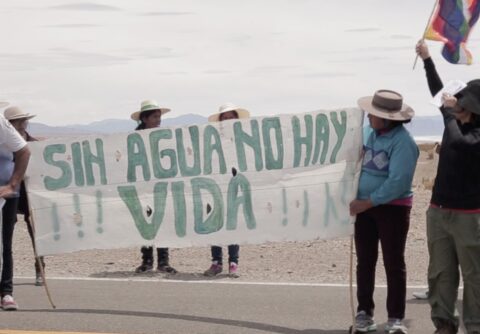
    “Water is worth more than lithium,” Indigenous Argentine community tells COP30

    Rich in lithium but poor in water, traditional Andean communities want the world to recognise the pitfalls of surging demand for minerals vital to the global energy transition
    Read more
  • Nov 9, 2025
    Sponsored

    A just transition for renewables: Why COP30 must put people before power

    Across the world, people hosting renewable energy projects are seeing few rewards. Advocates say a Belém Action Mechanism could make the green transition fairer
    Read more

    Other stories

    Apr 17, 2026
    Politics

    Q&A: Look beyond Trump for the full story on US climate action, says university dean

    Lawyer Lou Leonard, who leads the climate school at Clark University, says Washington’s attacks haven’t halted climate efforts across American society
    Read more
    Apr 16, 2026
    News

    US pressure puts World Bank’s climate plan at risk

    Closed-door talks over the World Bank’s climate agenda have stalled, as the US pushes to scrap green targets and expand support for fossil fuels
    Read more
    Apr 16, 2026
    Clean Energy Frontier

    As US and China seek rare earths, Brazilian lawmakers push for state-owned developer

    Pro-government lawmakers want Brazil to use mining for rare earths, key to many green technologies, to drive economic development
    Read more
    Apr 16, 2026
    Comment

    EU carbon tax risks penalising efficient producers over data gaps

    As importers face new costs under the Carbon Border Adjustment Mechanism, many are finding the biggest savings do not necessarily come from swapping to cleaner production
    Read more
    Apr 15, 2026
    News

    IEA slashes pre-war oil demand forecast by nearly a million barrels per day

    As the Iran war upends global energy markets, governments and consumers are cutting back – potentially locking in demand reductions that could lower the outlook for planet-heating emissions
    Read more
    COP16 confronts "huge" challenge of protecting 30% of world's land and sea
    Apr 15, 2026
    Comment

    Fossil Free Zones can be on-ramps to the clean energy transition

    Oil and gas blocks overlap with a fifth of forests in the Amazon, Congo Basin and SE Asia – policies are needed to transition away from fossil fuels and halt deforestation together
    Read more
    Apr 14, 2026
    Politics

    Türkiye sets COP31 dates and appoints Australian cattle farmer as youth champion

    In an open letter, Murat Kurum gives details of the October Pacific pre-COP and the November COP31 leaders’ summit in the Turkish city of Antalya
    Read more
    Apr 14, 2026
    Comment

    Broken debt system must be fixed to confront future climate shocks

    New UN-supported forum should challenge a global system that leaves many Global South nations with zero fiscal breathing space to navigate climate disasters and economic crises
    Read more
    Petrus Asuy sow forest crops seed in his nursery in Muara Tae Village, East Kalimantan Province of Indonesia on September 2015. The crops would be planted in the intact forest as part of community reforestation. Of their original 11.000 hectares of land, only 400 hectares can survive when the rest were destroyed by palm oil plantations and coal mining. In 2015, United Nations awarded Equator Prize to Muara Tae Community to recognize their effort in protecting ancestral forest. Agriculture and agroforestry are the primary income for indigenous people in Indonesia. Forest and agriculture land conversion for monoculture plantations and coal mining have threaten the indigenous communities. When the threat become rampant, indigenous people believe that planting trees and farming are considered as an act to protect their land.
    Apr 10, 2026
    News

    GEF raises $3.9bn ahead of funding deadline, $1bn below previous budget

    Amid aid cuts, donor governments pledge less nature and climate funding to the Global Environment Facility (GEF), with the four-year package to be finalised in late May
    Read more
    An aerial view of a deforested zone in "Ñembi Guasu" conservation area, in Bolivia.
    Apr 10, 2026
    Comment

    How a global roadmap can meet the promise to halt deforestation

    Meeting the goal requires political will and a pathway that brings together efforts and drives implementation. An international roadmap can deliver this
    Read more
    Climate Home News is an award-winning independent digital publication reporting on the international politics of the climate crisis.

    • News
    • Clean Energy Frontier
    • Investigations
    • Comment
    • Sponsored
    • Explainers
    • Subscribe at Climate Home News
    • Advertising, partners and sponsorship
    • Contact us
    • Privacy policy
    • Cookie Policy
    • Terms of Use
    DESIGNED BY SPOOVIO | DEVELOPED BY XT

    Stay ahead with our unrivalled coverage

    We provide experts and professionals around the world with the analysis and insight they need to navigate the biggest climate issues and negotiations.

    Sign Up

    Sign up today to gain immediate access.

    Login

    Login if you already have an account.

    Manage Cookie Consent
    To provide the best experiences, we use technologies like cookies to store and/or access device information. Consenting to these technologies will allow us to process data such as browsing behavior or unique IDs on this site. Not consenting or withdrawing consent, may adversely affect certain features and functions.
    Functional Always active
    The technical storage or access is strictly necessary for the legitimate purpose of enabling the use of a specific service explicitly requested by the subscriber or user, or for the sole purpose of carrying out the transmission of a communication over an electronic communications network.
    Preferences
    The technical storage or access is necessary for the legitimate purpose of storing preferences that are not requested by the subscriber or user.
    Statistics
    The technical storage or access that is used exclusively for statistical purposes. The technical storage or access that is used exclusively for anonymous statistical purposes. Without a subpoena, voluntary compliance on the part of your Internet Service Provider, or additional records from a third party, information stored or retrieved for this purpose alone cannot usually be used to identify you.
    Marketing
    The technical storage or access is required to create user profiles to send advertising, or to track the user on a website or across several websites for similar marketing purposes.
    • Manage options
    • Manage services
    • Manage {vendor_count} vendors
    • Read more about these purposes
    View preferences
    • {title}
    • {title}
    • {title}