• News ▾
    • Politics
    • Energy
    • Justice
    • Finance
    • Business
    • Science
    • Nature
    • Carbon markets
    • Explainers ▾
      • Clean energy transition
      • Sustainable Aviation Fuel
    • All news
  • Investigations
  • Series ▾
    • Clean Energy Frontier
    • Aviation’s Green Dream
  • Comment
  • About ▾
    • About
    • The team
    • Write for us
    • Advertising, partners and sponsorship
  • Contact
Sign In Subscribe Now
  • News ▾
    • Politics
    • Energy
    • Justice
    • Finance
    • Business
    • Science
    • Nature
    • Carbon markets
    • Explainers ▾
      • Clean energy transition
      • Sustainable Aviation Fuel
    • All news
  • Investigations
  • Series ▾
    • Clean Energy Frontier
    • Aviation’s Green Dream
  • Comment
  • About ▾
    • About
    • The team
    • Write for us
    • Advertising, partners and sponsorship
  • Contact
Sign In Subscribe Now
Partner Content
Mar 13, 2024 | Last Update: Sep 7, 2025
Sponsored

Indigenous peoples give fresh impetus to fight against climate crisis

Around the world, Indigenous peoples are using ancestral knowledge to adapt to extreme weather events and protect ecosystems
Participants in a food security project on the Colombia-Ecuador border in Awa Indigenous territory, implemented by the World Food Programme and funded by the Adaptation Fund (Photo: WFP)

Adam Wentworth

Author

Sponsored articles are produced by Climate Home News journalists with the support and collaboration of partners on topics of mutual interest.

Learn more
Share:
  • X (Twitter)
  • Facebook
  • LinkedIn
  • WhatsApp
  • Email

In 2007, a majority of member states at the United Nations signed the Declaration on the Rights of Indigenous Peoples. It was an historic occasion, giving voice to millions of people whose connection to their lands often dates back millennia.

The declaration is thorough in its recognition of Indigenous peoples’ fundamental freedoms, stating that they have “the right to the conservation and protection of the environment and the productive capacity of their lands or territories and resources”.

The importance and value that Indigenous peoples bring to tackling climate change is essential. Local communities should be at the heart of how to solve the climate crisis not only because they are at risk. Their connection to place provides unique insights into how to adapt to increasingly frequent extreme weather events. They have been the custodians of their land and water for generations – and the knowledge that brings is priceless.


Advertisement

The Adaptation Fund has financed multiple projects around the world where Indigenous peoples are being impacted by climate change. This offers the Fund unique opportunities to explore how climate adaptation can be implemented in lockstep with Indigenous knowledge.

Restoring forest

One such opportunity comes from a project that faced challenging circumstances in the deep jungle between Ecuador and Colombia. The project, implemented by the World Food Programme (WFP), covers an area of over 915,000 hectares and two watersheds important to both countries.

The region’s Afro and Awá communities live in precarious conditions there, affected by extreme weather events including drought, floods and storm surges. This border area is one of the most food-insecure regions in Latin America. Changes in climatic conditions have meant loss of mangrove forests, unstable crop production and a decline in fish species. This is having a knock-on effect on people’s diet, and malnutrition is increasing.

To address these issues, WFP worked closely with communities to raise awareness of climate risks and incorporated ancestral knowledge into adaptation measures. Restoring over 8,000 hectares of forest helped the livelihoods of 120 communities and 1,100 families in the region. In addition, the creation of resilient family gardens using organic products has helped to improve the diet of a further 600 families.

Using these techniques, alongside other activities such as sustainable agroforestry, helped to protect against damage from heavy rains. At each step, WFP has worked with communities imparting their knowledge and sought to empower local people. This included greater representation for women who, given historic inequalities, are more exposed to climate-related risks.

Local knowledge

The project faced unique challenges: the partners had to navigate working across borders in a large and remote region where there are serious security concerns. Diego Guzmán, the WFP’s national programme officer for food systems and climate change, worked closely on the project. He told Climate Home that the team maintained a line of communication to the UN’s security unit in Ecuador. “We actively engaged local organisations and leaders, leveraging their intimate knowledge of the territory,” he said. This solved some of the additional obstacles of size and borders.


Advertisement

Improving food security and its relationship to climate change among the community was one of the key components of the project. This first meant understanding and respecting traditional norms. “It’s crucial to acknowledge and value the local products that hold significance within these communities, fostering sustainable use of resources for improved food security and economic well-being,” said Guzmán. One of the key lessons from the project – and others like it – is to strengthen how local organizations work. Decisions need to be “inclusive, transparent, and reflective of the community’s priorities,” he added.

It is the sense of mutual respect and a shared end goal that supports the success of these projects. The Fund has also seen other significant components aimed at restoring sustainable ancestral practices in projects it funds in Morocco (reviving ancient underground water channels to address drought), Costa Rica (diversified forest farming to enhance food security), and Mexico (adapted fog catchers to store water), among others. 


Local women in South Sulawesi, Indonesia, taking part in an
adaptation project seeking to diversify food and livelihood security.
Photo credit: Adaptation Fund

Diversifying incomes

Mikko Ollikainen, head of the Adaptation Fund, said the organisation “takes great pride in supporting and empowering the most vulnerable local communities and groups, and you see this across many of our projects on the ground”.

“Our five-year medium-term strategy and environmental and social safeguards further foster support of human rights and equitable opportunity, including for Indigenous communities, which very often have the best ideas of what works well locally in building climate resilience,” he explained. 

Another related Indigenous project comes from the other side of the world, on the Indonesian island of  Sulawesi in South Sulawesi province. It aimed to raise awareness of watershed and climate impacts among the Indigenous people of Ammatoa Kajang. The implementing entity was Kemitraan, or the Partnership for Governance Reform in Indonesia, a non-profit established in the country for the past two decades.

Here the challenge was to reduce climate-related vulnerabilities through improving how the watershed was managed. This included the creation of different social business groups to help people diversify incomes, selling existing products like candlenuts in more profitable ways, and upgrading crop machinery. Not only did this approach require a climate adaptation plan based on local knowledge, but active lobbying of the regional government to see it implemented over the long-term. Again, strengthening local governance was seen as key.

A shift in thinking

One of the project participants, Namesiah Munaati, told the Adaptation Fund: “What has changed is the mindset of the community – a shift in thinking, from farming practices to managing agricultural products and marketing strategies.”

“There has been an improvement in our family finances. There is enough for children’s allowances and our household needs are met,” she added.

It’s no secret that outside entities have not always acted with local concerns in mind when developing plans and projects designed to support people on the ground. As Indigenous rights have grown in prominence, so has awareness among external partners. There is now recognition that working in partnership with Indigenous people will empower and protect their unique cultures to face new threats including climate change, ensuring their survival for decades to come.

Sponsored by the Adaptation Fund. See our supporters page for what this means.

Adam Wentworth is a freelance writer based in Brighton, UK.

TAGS:
Indigenous, Indigenous knowledge, Indigenous People

Benefit from more essential insight

Our unprecedented reporting provides experts and professionals globally with the analysis and insight they need to navigate the most important climate issues.

Trusted by the UN, World Bank, and governments around the world, sign up today and see why our award-winning coverage has been considered the authority for almost 15 years.

Essential

£0

A few top stories each week alongside our Climate Weekly newsletter.

Register for free
BEST VALUE

Premium

£130

per year

Unlimited access to our expert coverage alongside our Climate Weekly newsletter.

Subscribe today

Premium

£40

per quarter

Unlimited access to our expert coverage alongside our Climate Weekly newsletter. You can upgrade to an annual subscription at any time.

Subscribe today

Stories from the same category

  • Mar 30, 2026
    Sponsored

    Island nations fight to save cultural heritage from climate change

    The climate crisis is putting human heritage in the firing line. In response, small island states are learning how to adapt
    Read more
  • Mar 24, 2026
    Sponsored

    Early warning systems are saving lives in Central Asia

    Across Asia, the installation of early warning systems, alongside community involvement, is now viewed as a key response to the ever-present threat of climate disasters.
    Read more
  • Anabella Rosemberg of CAN International delivers the final intervention by environmental NGOs at the closing COP30 plenary
    Dec 10, 2025
    Sponsored

    How Belém launched the Just Transition mechanism

    COP30’s headline win – the creation of the first global Just Transition mechanism – did not materialise overnight. Born out of years of work, it flourished during two weeks of civil society alignment in one of the few negotiating tracks that gained momentum
    Read more
  • Nov 15, 2025
    Sponsored

    COP30: Spain’s unions say just transition means renewing communities beyond jobs

    Spain has made good progress in supporting workers to transition away from fossil fuels. But trade unions are pushing for stronger efforts to renew rural life
    Read more
  • Nov 13, 2025
    Energy

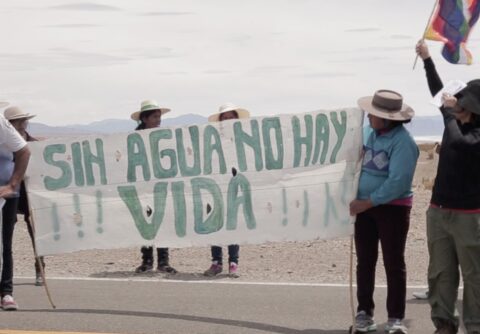
    “Water is worth more than lithium,” Indigenous Argentine community tells COP30

    Rich in lithium but poor in water, traditional Andean communities want the world to recognise the pitfalls of surging demand for minerals vital to the global energy transition
    Read more
  • Nov 9, 2025
    Sponsored

    A just transition for renewables: Why COP30 must put people before power

    Across the world, people hosting renewable energy projects are seeing few rewards. Advocates say a Belém Action Mechanism could make the green transition fairer
    Read more

    Other stories

    Apr 17, 2026
    Politics

    Q&A: Look beyond Trump for the full story on US climate action, says university dean

    Lawyer Lou Leonard, who leads the climate school at Clark University, says Washington’s attacks haven’t halted climate efforts across American society
    Read more
    Apr 16, 2026
    News

    US pressure puts World Bank’s climate plan at risk

    Closed-door talks over the World Bank’s climate agenda have stalled, as the US pushes to scrap green targets and expand support for fossil fuels
    Read more
    Apr 16, 2026
    Clean Energy Frontier

    As US and China seek rare earths, Brazilian lawmakers push for state-owned developer

    Pro-government lawmakers want Brazil to use mining for rare earths, key to many green technologies, to drive economic development
    Read more
    Apr 16, 2026
    Comment

    EU carbon tax risks penalising efficient producers over data gaps

    As importers face new costs under the Carbon Border Adjustment Mechanism, many are finding the biggest savings do not necessarily come from swapping to cleaner production
    Read more
    Apr 15, 2026
    News

    IEA slashes pre-war oil demand forecast by nearly a million barrels per day

    As the Iran war upends global energy markets, governments and consumers are cutting back – potentially locking in demand reductions that could lower the outlook for planet-heating emissions
    Read more
    COP16 confronts "huge" challenge of protecting 30% of world's land and sea
    Apr 15, 2026
    Comment

    Fossil Free Zones can be on-ramps to the clean energy transition

    Oil and gas blocks overlap with a fifth of forests in the Amazon, Congo Basin and SE Asia – policies are needed to transition away from fossil fuels and halt deforestation together
    Read more
    Apr 14, 2026
    Politics

    Türkiye sets COP31 dates and appoints Australian cattle farmer as youth champion

    In an open letter, Murat Kurum gives details of the October Pacific pre-COP and the November COP31 leaders’ summit in the Turkish city of Antalya
    Read more
    Apr 14, 2026
    Comment

    Broken debt system must be fixed to confront future climate shocks

    New UN-supported forum should challenge a global system that leaves many Global South nations with zero fiscal breathing space to navigate climate disasters and economic crises
    Read more
    Petrus Asuy sow forest crops seed in his nursery in Muara Tae Village, East Kalimantan Province of Indonesia on September 2015. The crops would be planted in the intact forest as part of community reforestation. Of their original 11.000 hectares of land, only 400 hectares can survive when the rest were destroyed by palm oil plantations and coal mining. In 2015, United Nations awarded Equator Prize to Muara Tae Community to recognize their effort in protecting ancestral forest. Agriculture and agroforestry are the primary income for indigenous people in Indonesia. Forest and agriculture land conversion for monoculture plantations and coal mining have threaten the indigenous communities. When the threat become rampant, indigenous people believe that planting trees and farming are considered as an act to protect their land.
    Apr 10, 2026
    News

    GEF raises $3.9bn ahead of funding deadline, $1bn below previous budget

    Amid aid cuts, donor governments pledge less nature and climate funding to the Global Environment Facility (GEF), with the four-year package to be finalised in late May
    Read more
    An aerial view of a deforested zone in "Ñembi Guasu" conservation area, in Bolivia.
    Apr 10, 2026
    Comment

    How a global roadmap can meet the promise to halt deforestation

    Meeting the goal requires political will and a pathway that brings together efforts and drives implementation. An international roadmap can deliver this
    Read more
    Climate Home News is an award-winning independent digital publication reporting on the international politics of the climate crisis.

    • News
    • Clean Energy Frontier
    • Investigations
    • Comment
    • Sponsored
    • Explainers
    • Subscribe at Climate Home News
    • Advertising, partners and sponsorship
    • Contact us
    • Privacy policy
    • Cookie Policy
    • Terms of Use
    DESIGNED BY SPOOVIO | DEVELOPED BY XT

    Stay ahead with our unrivalled coverage

    We provide experts and professionals around the world with the analysis and insight they need to navigate the biggest climate issues and negotiations.

    Sign Up

    Sign up today to gain immediate access.

    Login

    Login if you already have an account.

    Manage Cookie Consent
    To provide the best experiences, we use technologies like cookies to store and/or access device information. Consenting to these technologies will allow us to process data such as browsing behavior or unique IDs on this site. Not consenting or withdrawing consent, may adversely affect certain features and functions.
    Functional Always active
    The technical storage or access is strictly necessary for the legitimate purpose of enabling the use of a specific service explicitly requested by the subscriber or user, or for the sole purpose of carrying out the transmission of a communication over an electronic communications network.
    Preferences
    The technical storage or access is necessary for the legitimate purpose of storing preferences that are not requested by the subscriber or user.
    Statistics
    The technical storage or access that is used exclusively for statistical purposes. The technical storage or access that is used exclusively for anonymous statistical purposes. Without a subpoena, voluntary compliance on the part of your Internet Service Provider, or additional records from a third party, information stored or retrieved for this purpose alone cannot usually be used to identify you.
    Marketing
    The technical storage or access is required to create user profiles to send advertising, or to track the user on a website or across several websites for similar marketing purposes.
    • Manage options
    • Manage services
    • Manage {vendor_count} vendors
    • Read more about these purposes
    View preferences
    • {title}
    • {title}
    • {title}